
Records show that a chapel existed at Welland in the late 13th century and there was a church by 1340. The original Church of St. James stood between Welland Court and The Old Vicarage at the end of Welland Court Lane. The graveyard is still there and is owned and maintained by Welland Parish Council.
We are fortunate to have this document listing the parish’s vicars as far back as 1300. We know a little more about some of the people mentioned, so have picked out a few:
1520 Anthonius (Anthony) Morton: According to the CCEd website (Clergy of the Church of England database), Anthony Morton died from natural causes on 10th April 1548. His will was written on 6th March of that year, so it appears he suspected he might die soon. His will has been transcribed and from that we discovered a lot about the domestic arrangements for cooking over a large open fire in the kitchen and how he lived, also details about his clothing – certainly not what one might imagine of a country vicar in a small village. One might visualise that a country vicar of this era would be wearing quite simple, un-ostentatious clothing, possibly something ‘clerical’ most of the time. But our vicar was definitely wearing the clothes of a wealthy gentleman. His wardrobe included doublets and hose, waistcoats of damask, satin and silk; shirts of the finest fabric woven from wool, silk and angora hair; one of the cloaks he possessed was of fine wool from St. Omer, France.
1636 Thomas Evans – see article about his memorial here
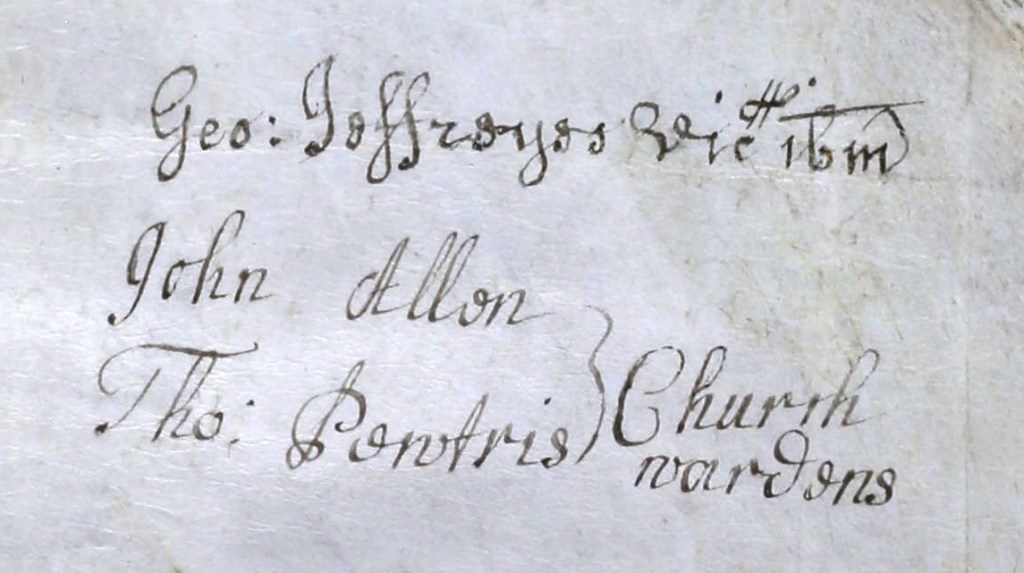
1685 Georgius (George) Jeffryes: Should be spelled “Jeffreyes”. His own signature is on many pages of Parish Records. One such sheet from 1720 is pictured here. In the writing at this time, the ‘e’ and the ‘o’ could look very similar, but the ‘e’ has a loop at the top whereas the ‘o’ does not.

1762-1876 Three related Boulters: George, John (son of George) and Henry (cousin of George).
The following text is from a newspaper article written by a fifth generation relative of George:
“The (Boulter) family appear to have reached the height of prosperity and influence at the time of my grandfather the Rev. George Boulter. He held at the same time for nearly thirty years the livings of Kempsey and Welland; in addition he held the Manor of Kempsey. His son followed him as Vicar of Welland, who in turn was followed by his cousin Henry. The family held the living at Welland for over sixty years. George Boulter is buried in Kempsey churchyard together with his two wives (one of which was was Ann Hester of the Parish of St. Peter’s, Worcester who he married on 8th Feb 1758). He was a well educated scholar, making margin notes in his sermon book in Greek. George employed twelve curates for the two parishes.”
1762 George Boulter gained an MA at Balliol College, Oxford and was appointed Vicar of Welland from 26th June 1762 until his resignation on 22nd January 1795. He died at Kempsey on 27th June 1798.
1795 John Boulter gained a BA from Worcester College, Oxford and was ordained as a deacon on 26th May 1771. He was ordained as a priest 14th June 1772 and appointed Vicar of Welland 22nd January 1795, until his death 1st September 1797.
1797 Henry Boulter was born and baptised on 6th May 1759 in Welland. He gained a BA at Trinity College, Oxford and ordained as a deacon on 26th May 1782. He subsequently gained an MA at the same College and was ordained as a priest with status as curate of Welland on 11th June 1786. Henry was appointed Vicar of Welland on 1st September 1797. His appointment continued until 12th February 1828.
 Exploring Welland