Welland Court is right in the south-east corner of the parish at the end of Welland Court Lane (see map). A house has probably been standing on this site since at least the 13th century, immediately adjacent to the village’s original graveyard and church.
For some period of its history the house and its land formed the manor of Dauncies or Daunseys, separate from the manor of Welland. Dauncies was owned by the Wa(l)pole and Daunsey families in the 15th century. It then passed to the Mucklowe family of Worcester in 1515-16. One of their tenants at Dauncies was probably Edmund Stokes. The lay subsidy records for Welland the 1520s list him as worth more than anyone else in Welland and therefore subject to the highest tax.
The estate may have changed hands to Robert Pratt around 1600. His will of 1619 is the first document we have come across that gives both names: ‘all that capital messuage and farm called Welland Court or Dansies Farm’.
Freddie Charles (1912 – 2002), an architect who specialised in conserving and repairing timber-framed buildings, visited Welland Court in 1973, recording his visit in two pages of sketches and notes. He concluded that it had been a timber-framed house built about 1600 in a U-shape. Later alterations encased the timber-framing in brick and enclosed the courtyard, forming the continuous west front seen today. The date would fit with the Pratt family’s apparent move to Welland and it is possible therefore that Robert Pratt was the builder of the current house. Whether any of the previous dwelling was incorporated into the new structure remains unknown.
Robert Pratt’s son, also Robert, sold the estate to John Bentall, merchant and citizen of London, in 1640. The Bentalls were connected by marriage to John Archer and Simon Archer of Welland. Bentall’s widow Ann sold the estate to Ralph Taylor in 1662.
We know from the Hearth Tax returns that Welland Court had nine hearths about this time, more than any other house in Welland. The Taylors were in possession until Allen Bright bought the house and estate in 1760. Originally a pewterer from Colwall, Herefordshire, Bright became a merchant in Bristol. Several other members of his family owned the Court after him but neither Allen Bright nor they seem ever to have lived there, the house and land being rented out instead.
In 1876 the estate was sold to the Ecclesiastical Commissioners for England and continued to be tenanted. The Trickett family bought it in the early 1940s and it was then sold to Philip and Elizabeth Archer in 1983. The Archers carried out a comprehensive programme of repairs and restoration and re-bought some of the land that previous owners had sold. The house changed hands again in 2022.
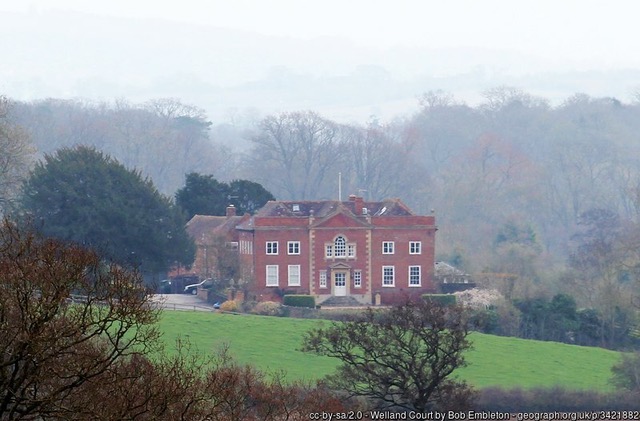
Photo: Bob Embleton, geograph-3421882
 Exploring Welland
Pingback: Robert Pratt | Exploring Welland