The earliest maps of the area do not show roads at all. Instead, they focus on watercourses as markers in the landscape. However, Speed’s 1610 map of Worcestershire shows a bridge at Upton, suggesting an east-west routeway through the region. Furthermore, Welland was part of Bredon manor in medieval times and goods and stock were transported between Welland and Bredon, again suggesting a regularly used route east-west. In the fourteenth century there are records of pigs from Bredon being sent to pasture in the woods at Welland and when logs were transported from Welland to the Severn by people from Bredon in 1395-6, a wassail was provided. Upton’s importance as a port created traffic through Welland – as early as 1289 the Bishop of Hereford had his wine sent from Bristol up the Severn to Upton, after which it was transported by land to his palace in Hereford.
It is possible that the east-west route has existed since prehistoric times. Welland lies close to the ancient frontier of the Malvern Hills, between a crossing of the River Severn (at Upton) and the Dobunni Iron Age hillfort at British Camp. Another Iron Age settlement (possibly a grain management site) has been found recently on the same route, on the far side of the river near Upton. The route extends on to Bredon Hill, yet another hillfort site. Thus the route passing through Welland may have been a significant part of the Dobunni communication and transport network.
At first sight, Welland appears to be in a relatively flat area but a look at a combined LIDAR/aerial image (zoom in towards the red dot and use the slider to view with aerial photography) shows the lumps and bumps of the topography. It therefore seems likely that the routeway, and possibly the village itself, are sited where they are because the brook has cut through a ridge here, providing easier access up to the higher ground and the Hills.
A 1628 survey map of Malvern Chase names the route as Drake Street as it passes through the village (still its name today). Drawings of houses on the 1628 survey map hint at the existence of other roads (or tracks) such as that along the edge of what was then Welland Common (now the B4208), and also Woodside Lane.
There will have been other routeways but these are not recorded on maps before the mid-nineteenth century. The road from Drake Street to Welland Court and the old church (see map) must have been a routeway for centuries. Byefield Lane (see map) is an example of a road that presumably existed in medieval times, passing as it does alongside Westfield, one of the village’s common fields. There are many footpaths over and around the common fields too – evidence that these have been rights of way for a very long time.
Some old routeways have been “lost” over the years. The 1628 survey map shows a route heading south in Little Malvern, at the base of the Malvern Hills and a 1720 plan of Little Malvern also marks this route, naming it as “the road to Gloucester”. This suggests it was a major road, now only discernible as various minor roads and tracks along the base of the steep slope of the hills.
Roadways did not always have a system of maintenance. From the sixteenth century, it was up to each parish to manage their road system and this was a haphazard affair, despite appointment of (unpaid) Surveyors of the Highways to supervise the work. Pot holes, ruts and mud abounded, resulting in frequently used routes becoming very wide as users tried to avoid the terrible conditions along the centre. A Welland example of local maintenance responsibilities comes from historical evidence from the sixteenth century that shows that the maintenance of the road bridge over the brook at Brookend was the responsibility of the one of the copyholders who was allowed to take wood from the Bishop’s land to maintain the bridge. But there are few references in Welland’s parish records to highway maintenance so it seems reasonable to assume that the parish did not make road maintenance a high priority. In 1633, Welland was one of several Worcestershire parishes to be rebuked for the state of its roads. During the latter part of the nineteenth century responsibility for the upkeep of the roads was gradually removed from the parish and placed in the hands of other authorities. However, one major road (what is now the A4104) ceased to be the responsibility of the parishioners much earlier than this. From 1663 onwards, turnpike trusts were empowered to build roads and levy tolls from users – see our separate article on Turnpikes and Tollhouses.
The A4104 remains a major route through Welland for traffic heading east-west between Upton on Severn and Ledbury, though the B4208 heading north-south has become a second significant road in more recent years, providing a route between Worcester and Gloucester (and to the M50). This road crosses what used to be Malvern Chase and, as the road crosses the southern parish boundary, it passes immediately into the largest remaining piece of the Chase, Castlemorton Common.
Other roads were created or enhanced as a result of the Welland Enclosure Act, as a result of which the part of Malvern Chase in Welland parish was enclosed. The Inclosure Map of 1849 marks the road from Danemoor Farm towards The Hook as “New Road”. Such roads are typically very straight, following new large field boundaries.
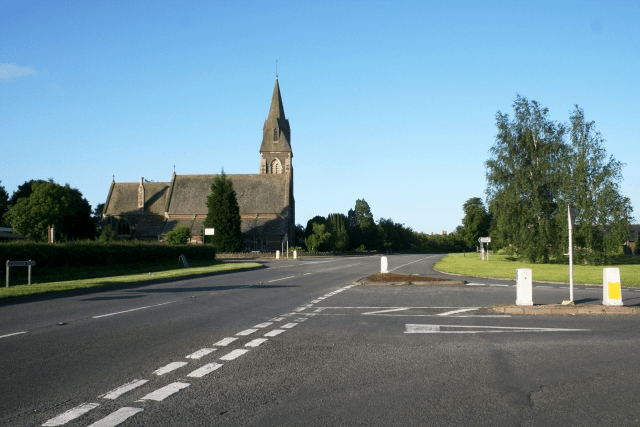
The crossroads of the A4104 and B4208 has stimulated recent development of the village around this point so that the area around the crossroads is now considered the village centre. The crossroads also demonstrates the continuing development of our road system – the school is now bypassed by the main road.
 Exploring Welland