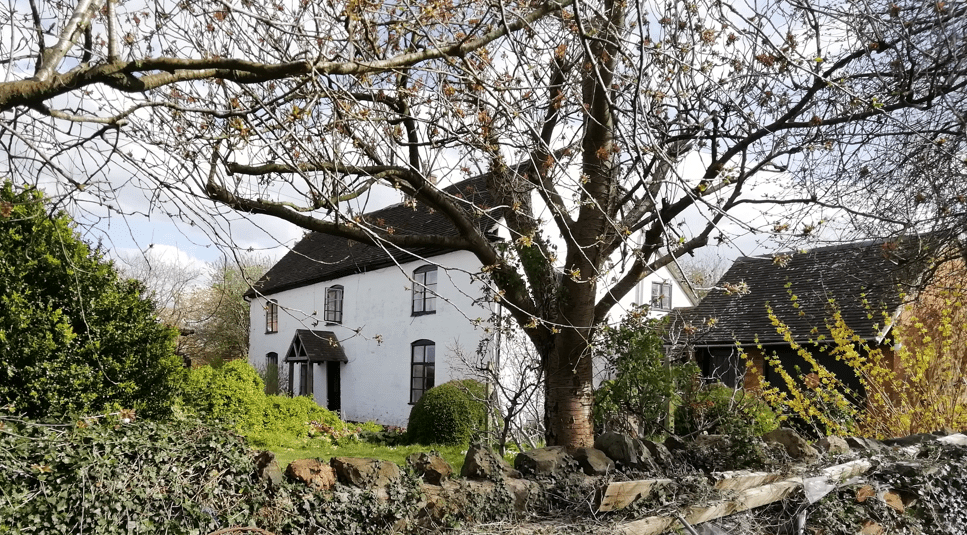
Church Farm House lies towards the western end of Drake Street (see map) and is relatively close to the current Church of St James from which it takes its name. However the farmhouse predates this church and this site has been occupied for many centuries and the property known by at least six names. (Note: Church Farm House is not the same property as Churches Farm.)
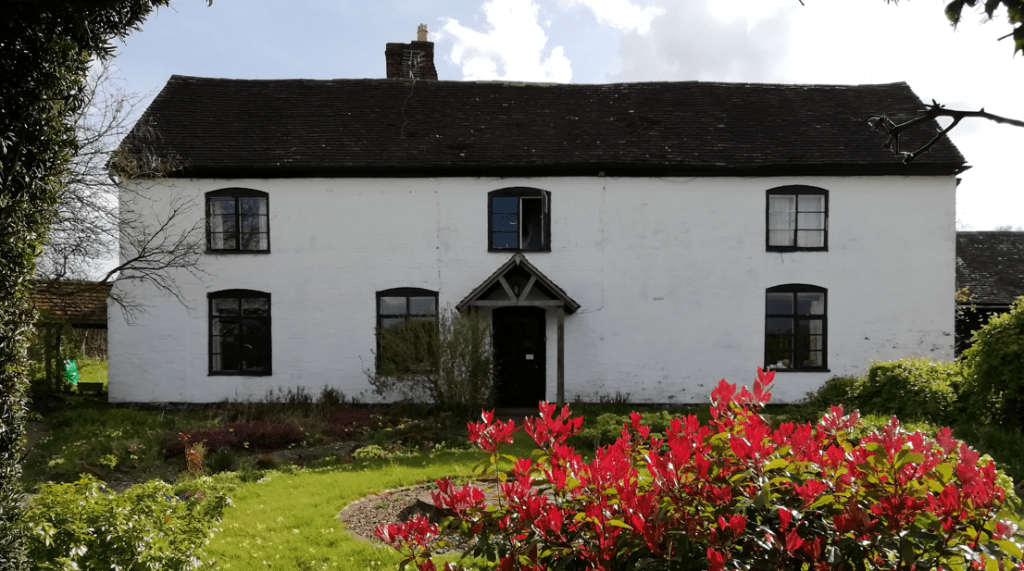
The current building dates from the 19th century although an earlier building was mentioned in the will of Richard Lutwich. Written in 1745, he bequeathed to his daughter Mary “… freehold messuages lands and tenements and hereditaments lying in the parish of Welland aforesaid which I purchased of Richard Turbevile clerk and one Thomas Sandy”. The land tax prepared for the following year includes:
Richard Lutwhich… and for Turbavills £1 1s 8d.
Turbavills (various spellings) is the earliest name for the property and it must have been in their family for a considerable period of time, possibly back to the middle of the 16th century (although they may only have lived in Welland until the early 17th century). John Lawrence was their tenant during the Civil War and he was assessed as having two hearths in the 1660s.
The rental for 1790 names the property as “Lutwiches or Turberfils” and occupied by Adam Hewitt. This leads to the third name, which appears in the 1828 Tithe book for Welland where the building is described as “Hewitts Homestead”.
John Morton of Worcester bought the farm in the first few years of the 19th century and he and his wife Ann owned it for nearly 75 years. The farm included about 25 acres of land. The first of their tenants was Richard Harris, who was one of three occupiers over the next 150 years to combine with the larger Lawn Farm, creating a larger holding. Much of this land was given over to orchards.
The land tax records show that Joseph Goode was the tenant of the farm and the electoral register for 1846 onwards name the property as “Batchfords”, presumably a name that he chose.
The farm was still associated with about 30 acres of land in 1851, but when single brothers George and Henry Boulter (who had been farming at Hill Court) became tenants they increased the land holding. In the 1861 census they were 73 and 72 years old respectively and supported by two live-in servants. They were farming 48 acres and employing two men and a boy.
The next tenants after this were Thomas and Emma Phelps who moved there in 1862, and eventually bought the property at the auction of the Morton estate (including two neighbouring cottages) in 1876. By the time of the 1881 census the property was known as “Yew Tree Farm”.
Thomas Phelps was a significant presence in the parish. He was elected parish constable in the early 1870s and was one of the Churchwardens during the period of construction and consecration of the new Church of St James from 1873 to 1875. When an artillery camp was held on Castlemorton Common in July 1876, with soldiers attending from a variety of places, it was reported that the meat was supplied by “Mr Phelps, butcher of Welland”. In the same month an auction of “two thousand gallons of prime cider, the property of Mr Thos. Phelps” was held.
By the time of the 1891 census, William (the 30 year old son of Thomas and Emma Phelps) and his wife Mary Ann were farming from the property. This census is the earliest reference to the property as “Church Farm”. This may have been the point where the smaller farm was reinstated as a separate entity and the name prompted by its proximity to the new Church.
The General Valuation Act resulted in a survey between 1911 and 1914 and described the building as brick and tiled with two sitting rooms, a kitchen and larder on the ground floor, four bedrooms and a landing on the first floor and two attics above. Outside, there was a brick and tiled butchers’ shop, as well as various thatched brick and half-timbered outbuildings, including a stable, barn and cart shed, and separate pig cots.
The Wastie family, who were known for their pioneering work with fruit, had moved to Lawn Farm soon after the Great War and combined Church Farm with their holding. Aerial photographs from the middle of the 20th century onwards show that virtually the whole estate was set to orchards. Their son Frank was living at Church Farm at the time of the 1939 Register and into the 1950s.
The current owner uses the name ‘Church Farm House’. This may be because the property is no longer a working farm. The farmland has been sold, leaving only the house, barn, outbuildings and a small amount of land.
 Exploring Welland