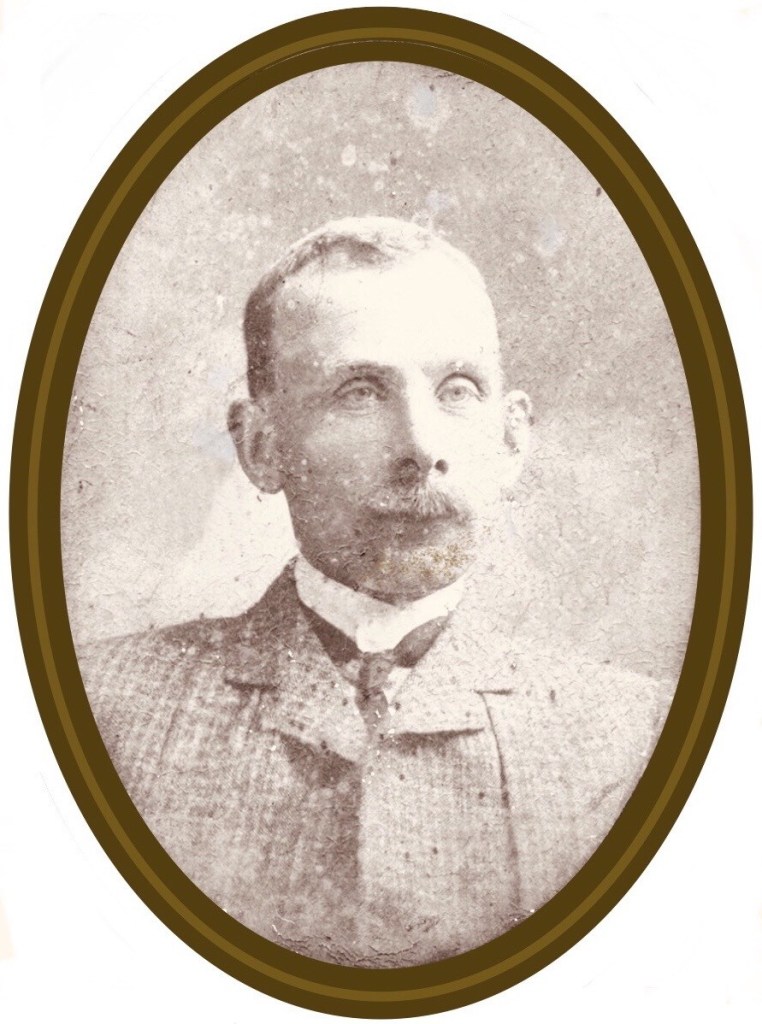
Curate of St. James’ Church, Welland, from 1864 to 1876, Vicar from 1876 until his death in 1882
Lionel Edward Darell Brown was born circa 1837 (estimated from census) and died on 11th February 1882 aged just 45. According to the Parish Register, he was conducting services until ten days before his death.
Lionel Brown and his wife Catherine were born in the East Indies. Lionel was born in Bombay where his father Henry was a civil servant. Catherine was born in Madras, her father was Physician General in the Madras Army. They married in Cheltenham – interestingly, the person who officiated at their marriage ceremony was Lionel’s uncle (his mother’s brother), the Reverend Sir William Lionel Darell. The couple soon relocated to Welland where their four children were born.
Lionel Brown was the Reverend Anthony Berwick Lechmere‘s nephew, so it was surely no coincidence that Brown came to Welland as Lechmere’s curate. The Revd. Lechmere was married to Lionel Brown’s aunt (his mother’s sister). Going back to Brown’s childhood in 1851, the Revd. Lechmere was living at No. 1 Churchend, Hanley Castle, with his wife and mother-in-law. The mother-in-law was Lionel’s maternal grandmother. Lionel was a live-in pupil aged 13 at the schoolhouse, No. 2 Churchend, so it appears that, as Lionel’s parents were still in India, he was sent back to England for schooling under the watchful eye of his aunt, uncle and grandmother. Lionel’s grandfather was born in Hanley Castle, so it is quite likely that a Lechmere / Darell connection had existed for some time.
From the time Lionel Brown came to Welland he lived at The Vicarage (now The Old Vicarage, next to Welland Court). In 1871 he was still there with his wife Catherine, three children and four servants. From 1874, he and his family lived at Heather Bank, Upper Welland, now known as The Chace Care Home. The New Vicarage in the village, Welland House, was built in 1880 at which time the Reverend and his family left Heather Bank and moved into it.
Lionel Brown came from a well connected family. His mother was Eliza Ann Verelst Darell before marriage, then she married Henry Brown. Eliza’s father was a 2nd Baronet and her brothers became 3rd and 4th Baronets. Around the time of Brown’s elevation from curate to vicar, he changed the family name to Darell-Brown by incorporating his third forename, which his wife and children subsequently adopted.
There was a very detailed account in the Worcestershire Chronicle dated 18th February 1882 of the Revd. Lionel Darell-Brown’s death and the subsequent inquest held at The Pheasant Inn, Welland. It was common in those days for inquests to be held at a local hostelry in the same village as the deceased. The jury concluded that although the cause of his death was clear – he had shot himself while alone in his bedroom – there was insufficient evidence to conclude whether or not it was deliberate, and an open verdict was returned. A friend stated that the deceased was known to be careless with the maintenance of his firearms and had been warned that it could result in an injury. Also, a member of the jury stated that he had examined the gun in question and found it had a very light trigger. The Reverend Darell-Brown left a wife and four children, the youngest of which was ten years old.
The story of his death is certainly a bizarre tale but it is worth noting that several details about his life came out at the inquest. The Reverend had been perfectly fit and healthy until the previous summer when he suffered an epileptic fit, from which he recovered. However, he had a second fit a week or so before his death. Prior to that he had been full of energy and had for many years past, as both curate and vicar of the parish, done everything he could to promote the welfare of the people committed into his charge. It was mainly through his exertions and with the help of friends that he, along with his predecessor the Revd. Lechmere, had been instrumental in getting a new church built in a more convenient place than the old one.
The aforementioned Reverend Sir William Lionel Darell, 4th Baronet (Lionel’s uncle), was the main landowner of Fretherne, Gloucestershire. When their old church needed a new replacement, he was the one who got it built and funded most of the work. Ten years later, in 1857, he paid for it to be improved and extended with a south aisle. The architect he selected for that project was John West Hugall. As Hugall was already known to the Darell family it would appear likely that the Darells recommended him to the Reverends Darell-Brown and Lechmere for the design of the new Church of St. James at Welland.
 Exploring Welland