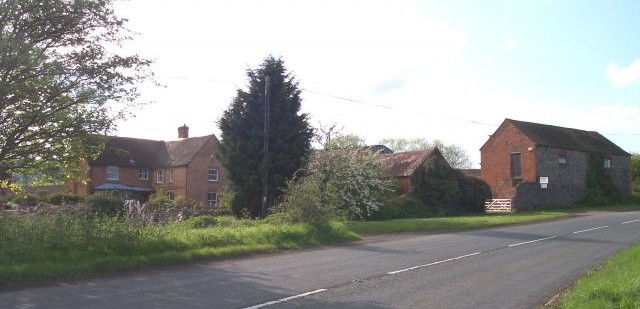
Dank Moore and Daintmore are early spellings of the modern Danemoor.
The map of the 1628 survey of Malvern Chase shows an area called Dank Moore marked by two brooks. In the early 1630s a third of Malvern Chase was enclosed so that it could be leased or sold to raise money for Charles I. One of the enclosures in Welland was ‘St Giles Oake’ and this was where most of Danemoor farm’s land was located. Daintmore Farm certainly existed by 1724, when it is mentioned in the constable’s rate records, but it may possibly date back to the 1630s. Another of the enclosures, ‘Lumber tree playne’, was also part of the Danemoor landholdings but this was taken over by Charles Mayfield Turner in 1822, when James Price, the Bishop’s tenant of the Welland Thirds, went bankrupt.
The farm buildings are arranged round a yard next to the house. The age of the current farmhouse is unknown but it is probably not the original one.
It is believed that the house registered by William Purser and five others as a meeting place for dissenters in 1788 was Danemoor farmhouse (see article about nonconformity in Welland).
On the 1812 Ordnance Survey drawing of Malvern Chase, Danemoor Farm can be seen on the edge of the enclosed land, with fields behind it and an orchard on the north side of the farm buildings, but the land between Danemoor and Welland was still part of Welland Common. This was divided up into fields under the enclosure award of 1853 and as part of this award, a road was built to connect Danemoor Farm with Welland. Blackmore Park Road leads from the crossroads straight towards Danemoor Farm then turns right up the hill towards Malvern.
Amongst the tenants was William Green, who was there by 1817, when James Price was the proprietor, and still there in 1833, by which time Thomas Jenkins owned the farm. Richard Hill had become tenant by 1839 and was still there in 1851, describing himself as a farmer of 96 acres.
The 1881 census shows that Alexander Roxburgh was the farmer at Danemoor and managing 196 acres. Born in Scotland in 1829, the son of a farmer, by 1861 he was a travelling draper in Dudley with a wife and children. Ten years later he was farming at Hockhams in Martley and at some point during the next decade he became the tenant of Danemoor. Alexander’s son David took over the tenancy from his father. The 1910 land valuation lists Duke Gandolfi of Blackmore Park as the owner of the house, buildings and 111 acres of land, and David Roxburgh as the occupier. It was the fourth largest Welland farm by acreage at this date.
By the time of the 1939 National Register, David Roxburgh was retired and Thomas and Mary Lloyd and their family were in residence at Danemoor.

