St James Church

St James Church was consecrated in April 1875, at a ceremony attended by the bishop of Worcester, clergy from the surrounding villages and further afield, and a large congregation of local people. Also, according to the report in the Worcestershire Chronicle of 10 April, ‘the labouring classes evinced warm interest in the proceedings’.

The Revd Anthony Berwick Lechmere, vicar of Welland and Hanley Castle, had long campaigned to raise funds for a new church. The site across the road from The Pheasant (see map) was donated by Abraham Watkins of Woodside Farm and the total cost of the building was about £4,000. The church could accommodate about 400 people.

A new church was necessary because the old church, next to Welland Court, was too far away from most of the village’s population by the mid-19th century. It was also too small, in a dilapidated state, and the graveyard was full. When plans were first made, it was intended to re-use timbers from the tower of the old church, but the wood proved too decayed to make this possible. The existing four bells did, however, provide some of the metal for the six bells of the new church, cast by Taylors of Loughborough.

John West Hugall of Oxford was the architect, and the building work was undertaken by Messrs. Geo. Wall and Henry Hook of Brimscombe, near Stroud. In the same spirit of modernisation, Welland’s new church was followed shortly afterwards by a new school, still in use today, and a vicarage, now Welland House Care Centre. Both were designed by Hugall.

The new church had some space around it for burials but land for a cemetery on Marlbank Road had already been provided for in the 1850s enclosure act. Interments date from the 1930s and the cemetery is still in use today.

Hugall’s plan of St James can be seen in the Artefacts in St James Church section, as can the list of Welland vicars from 1300 and other information on items linking the old and new churches.

This early 20th century postcard presents a clear view of St James taken from the adjoining field, now Purser’s Orchard. The tower clock was installed to mark the diamond jubilee of Queen Victoria in 1897.
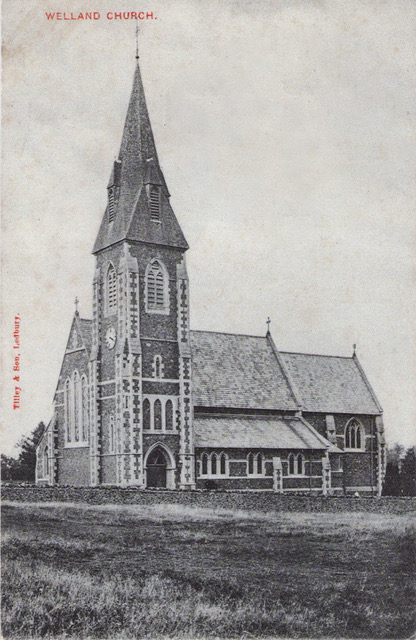
Photo: Malvern Museum

The most recent major changes to the church were made in 2010-2012 when the fixed pews were removed and building work was undertaken to make the internal space more flexible and provide a kitchen and toilets. A screen and projection equipment were installed in 2023 to enable films and live broadcasts to be shown. A series of special events took place from April to July 2025 to mark the church’s 150th anniversary and raise funds for ongoing work. Unfortunately, the weather vane, just visible in the postcard above, had to be removed in 2023 following storm damage.

Old St James Church

The first St James Church was at the end of Welland Court Lane, surrounded by a small graveyard (see map) and next to Welland Court. The ‘chapel of Wenlonde’ was in existence by 1288 and had been granted the status of a church by 1340 but we know nothing about this structure. It may have survived until the 17th century or been replaced during the interim. There was certainly a rebuild in 1672, according to a plaque that once hung in the chancel. The tower is thought to have been re-built in 1738.

Old St James’ Church, Welland, painting by Mary Brandling, 1856. Photo by Philip Blackman. Original painting in Malvern Library. Copyright holder (if any) unknown – please contact us if you want the image removed.

Most of the seats had to be paid for on a yearly basis and the major landowners were allocated specific pews. A plan of the seat allotments from 1829 shows that each seat contained two kneelings and the charge was three shillings per kneeling. But half of the allotted seats seemed to have no occupiers at the time, e.g. ‘Late Bullocks & Late Hewitts’, ‘Late Lulwitch & the Pheasant’. Eleven pews are listed for the south side and eight for the north side, where space had to be left for the pulpit. There was room available at the back of the church for those who did not pay for their seats. The church could accommodate only about 150 people.

A new church was consecrated in 1875 at the crossroads of Drake Street and the Gloucester Road and the old church was then demolished.

Local artist Mary Brandling was one of the last people to be buried in the old churchyard in 1873.

Photo: Philip Blackman

Today, a small metal gate gives access to the graveyard (looked after by Little Malvern and Welland Parish Council). Some gravestones survive but no trace of the church building remains. There is a slight depression in the ground marking the location of the chancel floor, under which a number of people are known to have been buried.

Photo: Bob Embleton, geograph-2876872

The only known description of the interior of the old church comes from the antiquary Peter Prattinton of Bewdley (1776-1840). He visited St James on 30 May 1820 and made detailed notes. He recorded that there were several monuments on the walls of the chancel and inscribed stones on the floor marking the burials of Archers and Taylors in the vault beneath. He noted the benefaction table, hanging over the chancel door. The pulpit hangings were white velvet with a red fringe and the royal arms of William and Mary. The tower had four bells dating from 1680, 1703, 1714 and 1721. He reported that the font was old and of stone, with three cherubims decorating the bowl. He also mentions a singing gallery, which must have been at the west end of the nave.

Waterways

No major waterways pass through Welland but, like most settlements in Britain, water has strongly influenced its development.

Welland is situated on the A4104, an old road linking Upton upon Severn with the pass through the Malvern Hills at British Camp and on to Herefordshire. The settlement is likely to have developed as a direct consequence of this link to the Severn, an important waterway for trade and travel. Links are traceable as far back as Anglo-Saxon times and likely go back much further.

There are a number of smaller waterways within the parish and several are used to form parts of the boundary, no doubt because they are linear, relatively stable and easily identifiable features in the landscape.

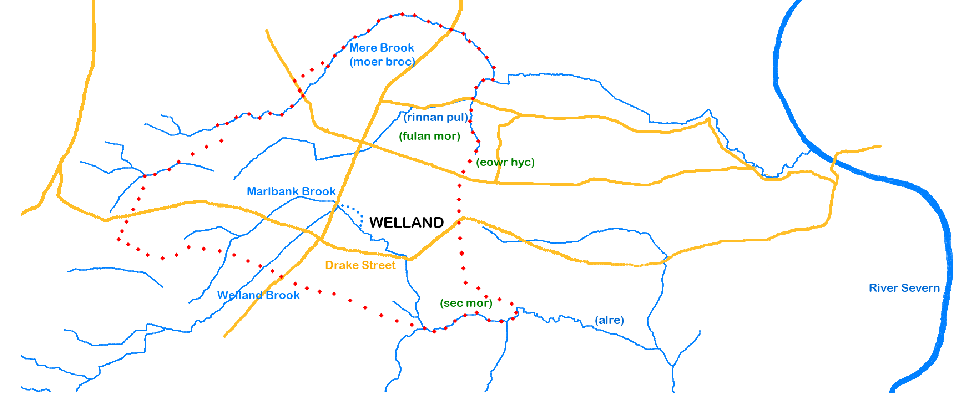
In the clay areas of Worcestershire, streams are plentiful enough to enable settlements to be sited near a water source and also have others as boundary markers. Thus, Mere Brook forms a substantial part of the northern boundary of the parish (parish boundary shown in red dots), whilst Marlbank Brook and Welland Brook go through the settlement itself. Marlbank Brook and Welland Brook join at the B4208 as it heads north out of the village (see OS map). The Brook then flows down to and alongside Drake Street towards Upton, before heading south to join other streams and enter the Severn further south. The Brook forms part of the south eastern edge of the parish boundary.

The importance of waterways as boundaries is shown by the fact that we have knowledge of the Anglo-Saxon names of several of the waterways, small as they are, because they are referenced in charters of the time demarcating estates. These names can be seen on the map below (in brackets after the modern name on the map). The names in green show other boundary clause topological features – fulan mor (foul marsh), sec mor (sedge marsh) and eowr hyc (yew ridge) – the first two hint at how much drainage has taken place as the area was subsequently developed.

At first sight, Welland appears a relatively flat area but a look at a combined LIDAR/aerial image shows the lumps and bumps of the topography. It looks likely that Drake Street and the village itself are sited where they are because the Brook has cut through a ridge to provide easier access up to the higher ground and the Hills.

A water mill is known to have been sited soon after the confluence of the Welland and Marlbank Brooks. In the 17th and 18th century this was known as Archer’s Mill but it is likely that there has been a mill at or near this location before then. Structural remains and the ghost of an access track can still be seen at the site and the remains of the mill leat can also be found (see map, mill leat marked with blue dots).

Tyre Hill Inn

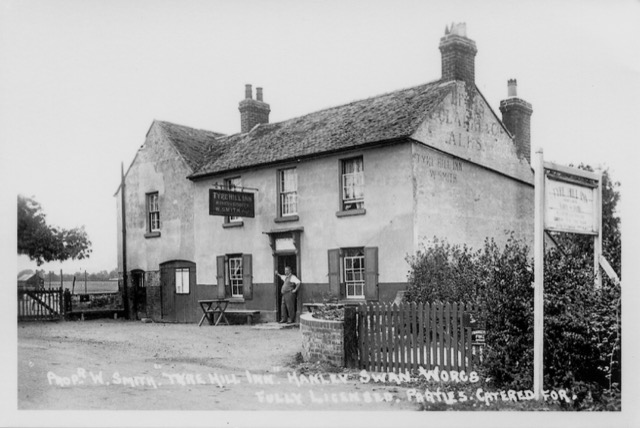
From at least 1861 to 1911, the licence of the Tyre Hill Inn, opposite the Tyre Hill estate on Welland Road in the north of the parish (see map), was held by the Vivian family. In the census returns John Vivian described himself as publican or innkeeper and bricklayer. Following his death in 1889, his widow Elizabeth took over and then one of their sons, Andrew.

The Vivians had moved by June 1912 when the Evesham Standard newspaper reported that the landlord of the Tyre Hill Inn, William Morris, had been accused by two police officers of being drunk in his own pub. He was acquitted by the helpful evidence of several customers, but a month later a notice appeared in the Standard that the licence had been transferred to William Hinton.

The 1928 Kelly’s Directory listed William Smith as proprietor and the postcard shown here dates from his time. The lettering on the gable wall reads ‘Lewis, Clarke & Co’, which was the name of a Worcester brewery.

In June 1938 Worcestershire Licensing Committee heard that Mrs Annie Elizabeth Smith, widow (presumably of William), held the licence at Tyre Hill but was referring it for compensation, i.e. she was prepared to close the pub in return for a payment. She reported that average trade was £15 per week and the premises were in a bad state of repair. It was probably at this time that it ceased to be a public house as it is not listed in the 1939 National Register.

It is a private residence today.